Monday, July 31, 2006

Following From Stratfor: Shift in Operations . . .

Shift in Israeli Operations

At this moment there appears to be a major shift taking place in the war. Though the scope of the operation is unclear, it appears the Israelis have shifted to a new phase of the war, focusing on broader and more intense ground operations. It could be that this is the opening phase of a broader raid-in-force against Hezbollah that might go beyond southern Lebanon. We do not know this for certain, but it does warrant alerting our readers to the possibility. Various bits of evidence point in this direction.

For example, early Sunday Israeli time, an Israel Defense Forces (IDF) spokesman was quoted as saying, "We have drawn our conclusions from battles in other areas, we have learned our lesson and are about to embark on another mission. There is no intention whatsoever to occupy this region or any other -- only to arrive, to act, and when we're done, to get out."


There are reports of new areas involved in fighting and new Israeli units being engaged. For example, Israeli forces are now fighting in the area of Qana. This is a few miles southeast of Tyre and deep into southern Lebanon. We have heard that the Qana action consists of engineers, armor and infantry, indicating a more traditional combined arms effort. The engineers would be clearing mines, bulldozing fortifications and clearing roads damaged by Israeli airstrikes. Infantry would be clearing the area of anti-tank teams and opening the way for broader armored thrusts to destroy rear infrastructure and isolate forward Hezbollah positions. There are additional reports of engagements near and to the west of the Israeli panhandle in the Dan-Dafna-Metulla region, along with heavy artillery fire in this region. This would be the jump-off point for an attack both westward along the Litani and northward into the Bekaa Valley. There were extensive reports of a major armored buildup in this area over the past 48 hours. This would also explain the decision to disengage temporarily at Bent Jbail in preparation for the new phase of operations.

Interestingly, the report about Qana that we have says the attacking force is from the Nahal Division. According to Israeli media, the Galilee Division, which normally has full responsibility for the entire Lebanese border, has been given responsibility for the western half of the border, while Nahal Division has been made responsible for the eastern half. If all of this is true and the Qana fighting is being carried out by Nahal, then the action at Qana represents a drive westward from the northern panhandle rather than a northern drive from Galilee division. This is of great importance because it indicates that the armor massed in the panhandle is moving in a broad encirclement as per traditional IDF doctrine. Nahal has been moving rapidly during daylight hours. Ground operations involving the Golani Brigade were also reported in Taibe last night. If Nahal moved west, it would have passed through Taibe. If the division were planning on a move north to the Bekaa Valley, it will need Taibe. The town is in a critical location.

U.S. Secretary of State Condoleezza Rice has canceled her visit to Lebanon. She is, however, going to meet with Israeli Prime Minister Ehud Olmert on Sunday night and return to the United States on Monday. If nothing important were happening, Rice would stick to her schedule. If the United States objected to what is happening, Israel would postpone until she left or she would be on the plane right now. Therefore, a logical conclusion is that whatever is happening makes her trip to Lebanon pointless or harmful but that she wants to signal that there is no strain in relations with Israel. If there is a major attack coming, Washington has signed off on it.

We are approaching nightfall in Israel. If this is indeed a major shift operationally -- and we simply cannot be certain at this point, in spite of pieces seeming to fall into place -- then we would expend rapid movements of Israeli forces through the night, and we should get a sense by morning, Israel time, of just how deep they expect to go. At this point, having made the decision to shift to larger-scale, more traditional operations, Israel will want to proceed as rapidly as possible for operational and diplomatic reasons. If the Israelis are going, they will be going rapidly.

It should also be noted that Israel attacked key roads and bridges along the Syrian-Lebanese border. This indicates that Israel is not intending to use those roads to attack Syria (otherwise they would have wanted them intact) but does want to protect its flank from any Syrian countermove. It is the least intrusive action Israel can take. They neither want to attack nor be attacked by Syria.

At this point, if this should take place, we will get a better sense of Hezbollah's broader capabilities. Its forward troops seemed to be extremely competent. Whether troops in other areas are equally capable remains to be seen. Also remaining to be seen is the effect of the Israeli air campaign on the militants' numbers, morale and coordination. If they are an effective fighting force, we would expect effective attacks against armored columns using anti-tank weapons and mines, and a slow evolution. If they are severely weakened, as some reports we are receiving from Lebanon say they are, the attack will be broader.

Remember that in our view Hezbollah does not expect to defeat Israel's main force, but wants to draw it into Lebanon to impose an Iraqi/Afghan style insurgency. Therefore, an apparent collapse of Hezbollah (as with the Taliban and Saddam Hussein's forces) does not necessarily mean defeat but rather can mean a shift to insurgency rather than conventional resistance. As the IDF statement makes clear, Israel does not intend to occupy and expose itself to such actions. It should also be remembered that both within and outside of Lebanon, Hezbollah has historically used terror techniques to impose penalties on enemies and shape the political environment. Hezbollah pioneered suicide bombing in Lebanon during the 1980s.

In conclusion, we do not have definitive intelligence that Israel has shifted to a radical new course. This could simply be another phase in a piecemeal operation. However, given Israeli practice in the past and political disputes within the Israeli government, we regard it as reasonable to alert our readers to the possibility of the beginning phases of a major, more traditional Israeli ground offensive designed to destroy Hezbollah in detail. We will know more clearly over the next 12 hours.

Sunday, July 23, 2006

Hizbullah Media

Concerned Citizen's Note: The following comes to us from Palestinian Media Watch. Also see www.memri.org as a definitive source of Arabic translations regarding the battle of civilizations with which the Judeo-Christian world (and more importantly, the moderate Islamic world) is confronted.

Palestinian Media Watch Bulletin - July 23, 2006

Contact details here

View this bulletin online here

Murder, martyrdom and blood libels are themes of Al Manar TV station
attacked by Israel

The International Federation of Journalists (IFJ) on Thursday condemned Israel for bombing the Hizbullah TV station Al-Manar, saying, "The bombing of Al-Manar is a clear demonstration that Israel has a policy of using violence to silence media it does not agree with." [IFJ General Secretary Aidan White, July 14, 2006, IFJ Web site]

To clarify to PMW subscribers, Al Manar television broadcasts not only material that Israel "does not agree with," but some of the most loathsome hate broadcasting in the world, which we are surprised the IFJ would condone. This has included using cartoons to encourage children to seek death as Martyrs, presenting Jews using Christian children's blood for Matzah as factual, and presenting the killing of Israel's Jews as God's will.

Click below to see these examples from Al Manar TV broadcasts:

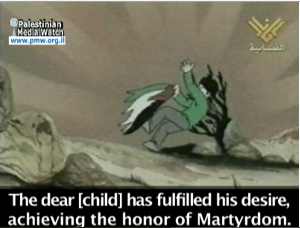
1. Cartoons brainwashing children to die as Shahids (Martyrs for Allah).

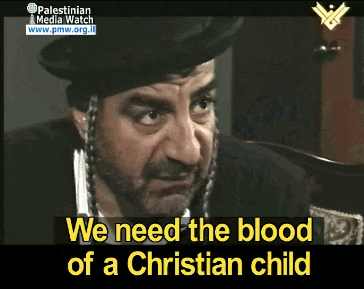
2. A drama, presented as historical fact, in which Jews slit the throat of a Christian child to get blood for Passover Matzah.

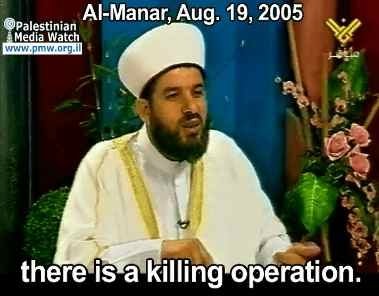
3. Religious leader presenting the conquering and killing of the Jews of Israel by Muslims as God's goal.


To see more examples from Al Manar click here to PMW archives.

The following are the full transcripts:

1. Cartoons brainwashing children to die as Shahids (Martyrs for Allah):

Enemies harm us
Oh children, cry Allah Akbar
You are the aim and the concern,
let your stone pour out blood
Your land is your honor and is what matters
It is your promise and your friend
My book has turned into a stone.
With it I repel the treacherous
My book has turned into a stone
With it I repel the treacherous
It is small like (the boy)
But its effect is great.
Purify yourself,
Pray and set out
Your blood perfumes that soil of your land
Your name will be engraved on heaven’s door
I swear my loyalty to you, Al Aqsa
I swear my loyalty to you, Jerusalem
I may miss a lesson
But my love for you itself is a lesson
Come out of every tunnel, window and door
Join your stone to mine.
Shooting doesn’t scare us
[child falls to the ground]

The dear (child) has fulfilled his desire,
Achieving the honor of Martyrdom,
He is not considered dead
He who dies for his country

2. A drama, presented as historical fact, in which Jews slit the throat of a Christian child to get blood for Passover Matzah.

The blood of Christian child for Passover Matzah
Scene I:
Two men talking.
Rabbi (speaking to a young man seated next to him): We have a task from the leadership. We need the blood of a Christian child before Passover for matza.
Scene II:

Dimly lit hallway. Rabbi with young man behind him. A third man enters dragging a child.
Christian child: Nathan save me!
Nathan: Don't be afraid.
Rabbi nods to the young man who nods to Nathan. Nathan forces the child down onto the floor and cuts his throat. Someone catches the blood in a bowl.
Scene III:
Rabbi and young man standing eating matzo. While chewing they nod to one another as if to say, We have done what we need to do.

3. Religious leader presenting the conquering and killing of the Jews of Israel by Muslims as God's goal.

Muhammad Ali Deputy Director of the Palestinian Clerics Association in Lebanon, Al-Manar, Aug. 19, 2005:

"The Prophet [Muhammad] foretold:
'The Resurrection will not come until the Muslims fight the Jews, and the Muslims will kill them, and the stone and tree will say: 'Oh, Muslim, servant of Allah, there is a Jew. It means of course the occupying Zionist Jew: 'there is a Jew behind me,come and kill him'. We will enter [Israel] as conquerors Allah willing, and will enter as liberators, not through negotiations, but through Jihad and resistance [terror], because the Hadith goes: 'The Muslims will kill them' - there is a killing operation."


To SUBSCRIBE to PMW reports,
send an e-mail to pmw@pmw.org.il with "SUBSCRIBE" in the subject line.

To UNSUBSCRIBE, send an e-mail
to pmw@pmw.org.il with "UNSUBSCRIBE" in the subject line.


VISIT PMW VIDEO ARCHIVES


Contact Palestinian Media Watch:

p:+972 2 625 4140

e: pmw@pmw.org.il

f: +972 2 624 2803

w: www.pmw.org.il


Friday, July 21, 2006

Stratfor Military Analysis of Israeli Ground Attack On Lebanon

Introduction, by Concerned Citizen:

Many, including myself, have been disappointed in Israel's civilian (and perhaps military) leadership in the current war in Lebanon. As a result of a lack of apparent experience, boldness or conviction (or all of the above), Israel has followed what at best can be described as a conventional, incremental military strategy, which has neither achieved the core objective of knocking out Hezbollah missile and rocket attacks on Israel, or otherwise dealt a harsh blow and decisive victory that would serve to re-establish Israel's deterrent position to its foes. Instead Hezbollah has siezed the initiative and persevered, continued the rocket attacks, and fought the Israelis toe-to-toe, achieving a significant victory in Arab public opinion. Israel now has lost any element of strategic or tactical surprise in attempting to root out its enemy on the ground. The tentativeness that Israel shows in launching this campaign is also somewhat disturbing, and again, of no use to Israel's psychological deterrence of its enemies. And worst for the Israelis, casualties will be no lower for them by having waited this long, instead of pursuing a bold ground attack strategy at the beginning of this conflict. And the Lebanese continue to suffer.

Don't get me wrong -- this is a bad situation no matter what the Israelis do and will not be solved by military measure alone, but as you will read below, it will probably only now get worse for the Israelis and the Lebanese, unless, perhaps, the Israelis go back to being themselves, take the strategic initiative and go for the jugular of Hezbollah -- that is, apply military pressure on the Syrian regime directly (but not seek to conquer Syria, as Stratfor discusses below), as we have discussed previously.

Stratfor Intelligence: Analysis of Strategic Options in Lebanon

SPECIAL REPORT
07.21.2006

Red Alert: The Battle Joined

The ground war has begun. Several Israeli brigades now appear to be operating between the Lebanese border and the Litani River. According to reports, Hezbollah forces are dispersed in multiple bunker complexes and are launching rockets from these and other locations.

Hezbollah's strategy appears to be threefold. First, force Israel into costly attacks against prepared fortifications. Second, draw Israeli troops as deeply into Lebanon as possible, forcing them to fight on extended supply lines. Third, move into an Iraqi-style insurgency from which Israel -- out of fear of a resumption of rocket attacks -- cannot withdraw, but which the Israelis also cannot endure because of extended long-term casualties. This appears to have been a carefully planned strategy, built around a threat to Israeli cities that Israel can't afford. The war has begun at Hezbollah's time and choosing.

Israel is caught between three strategic imperatives. First, it must end the threat to Israeli cities, which must involve the destruction of Hezbollah's launch capabilities south of the Litani River. Second, it must try to destroy Hezbollah's infrastructure, which means it must move into the Bekaa Valley and as far as the southern suburbs of Beirut. Third, it must do so in such a way that it is not dragged into a long-term, unsustainable occupation against a capable insurgency.

Hezbollah has implemented its strategy by turning southern Lebanon into a military stronghold, consisting of well-designed bunkers that serve both as fire bases and launch facilities for rockets. The militants appear to be armed with anti-tank weapons and probably anti-aircraft weapons, some of which appear to be of American origin, raising the question of how they were acquired. Hezbollah wants to draw Israel into protracted fighting in this area in order to inflict maximum casualties and to change the psychological equation for both military and political reasons.

Israelis historically do not like to fight positional warfare. Their tendency has been to bypass fortified areas, pushing the fight to the rear in order to disrupt logistics, isolate fortifications and wait for capitulation. This has worked in the past. It is not clear that it will work here. The great unknown is the resilience of Hezbollah's fighters. To this point, there is no reason to doubt it. Israel could be fighting the most resilient and well-motivated opposition force in its history. But the truth is that neither Israel nor Hezbollah really knows what performance will be like under pressure.

Simply occupying the border-Litani area will not achieve any of Israel's strategic goals. Hezbollah still would be able to use rockets against Israel. And even if, for Hezbollah, this area is lost, its capabilities in the Bekaa Valley and southern Beirut will remain intact. Therefore, a battle that focuses solely on the south is not an option for Israel, unless the Israelis feel a defeat here will sap Hezbollah's will to resist. We doubt this to be the case.

The key to the campaign is to understand that Hezbollah has made its strategic decisions. It will not be fighting a mobile war. Israel has lost the strategic initiative: It must fight when Hezbollah has chosen and deal with Hezbollah's challenge. However, given this, Israel does have an operational choice. It can move in a sequential fashion, dealing first with southern Lebanon and then with other issues. It can bypass southern Lebanon and move into the rear areas, returning to southern Lebanon when it is ready. It can attempt to deal with southern Lebanon in detail, while mounting mobile operations in the Bekaa Valley, in the coastal regions and toward south Beirut, or both at the same time.

There are resource and logistical issues involved. Moving simultaneously on all three fronts will put substantial strains on Israel's logistical capability. An encirclement westward on the north side of the Litani, followed by a move toward Beirut while the southern side of the Litani is not secured, poses a serious challenge in re-supply. Moving into the Bekaa means leaving a flank open to the Syrians. We doubt Syria will hit that flank, but then, we don't have to live with the consequences of an intelligence failure. Israel will be sending a lot of force on that line if it chooses that method. Again, since many roads in south Lebanon will not be secure, that limits logistics.

Israel is caught on the horns of a dilemma. Hezbollah has created a situation in which Israel must fight the kind of war it likes the least -- attritional, tactical operations against prepared forces -- or go to the war it prefers, mobile operations, with logistical constraints that make these operations more difficult and dangerous. Moreover, if it does this, it increases the time during which Israeli cities remain under threat. Given clear failures in appreciating Hezbollah's capabilities, Israel must take seriously the possibility that Hezbollah has longer-ranged, anti-personnel rockets that it will use while under attack.

Israel has been trying to break the back of Hezbollah resistance in the south through air attack, special operations and probing attacks. This clearly hasn't worked thus far. That does not mean it won't work, as Israel applies more force to the problem and starts to master the architecture of Hezbollah's tactical and operational structure; however, Israel can't count on a rapid resolution of that problem.

The Israelis have by now thought the problem through. They don't like operational compromises -- preferring highly focused solutions at the center of gravity of an enemy. Hezbollah has tried to deny Israel a center of gravity and may have succeeded, forcing Israel into a compromise position. Repeated assaults against prepared positions are simply not something the Israelis can do, because they cannot afford casualties. They always have preferred mobile encirclement or attacks at the center of gravity of a defensive position. But at this moment, viewed from the outside, this is not an option.

An extended engagement in southern Lebanon is the least likely path, in our opinion. More likely -- and this is a guess -- is a five-part strategy:

1. Insert airmobile and airborne forces north of the Litani to seal the rear of Hezbollah forces in southern Lebanon. Apply air power and engineering forces to reduce the fortifications, and infantry to attack forces not in fortified positions. Bottle them up, and systematically reduce the force with limited exposure to the attackers.

2. Secure roads along the eastern flank for an armored thrust deep into the Bekaa Valley to engage the main Hezbollah force and infrastructure there. This would involve a move from Qiryat Shimona north into the Bekaa, bypassing the Litani to the west, and would probably require sending airmobile and special forces to secure the high ground. It also would leave the right flank exposed to Syria.

3. Use air power and special forces to undermine Hezbollah capabilities in the southern Beirut area. The Israelis would consider a move into this area after roads through southern Lebanon are cleared and Bekaa relatively secured, moving into the area, only if absolutely necessary, on two axes of attack.

4. Having defeated Hezbollah in detail, withdraw under a political settlement shifting defense responsibility to the Lebanese government.

5. Do all of this while the United States is still able to provide top cover against diplomatic initiatives that will create an increasingly difficult international environment.

There can be many variations on this theme, but these elements are inevitable:

1. Hezbollah cannot be defeated without entering the Bekaa Valley, at the very least.

2. At some point, resistance in southern Lebanon must be dealt with, regardless of the cost.

3. Rocket attacks against northern Israel and even Tel Aviv must be accepted while the campaign unfolds.

4. The real challenge will come when Israel tries to withdraw.

No. 4 is the real challenge. Destruction of Hezbollah's infrastructure does not mean annihilation of the force. If Israel withdraws, Hezbollah or a successor organization will regroup. If Israel remains, it can wind up in the position the United States is in Iraq. This is exactly what Hezbollah wants. So, Israel can buy time, or Israel can occupy and pay the cost. One or the other.

The other solution is to shift the occupational burden to another power that is motivated to prevent the re-emergence of an anti-Israeli military force -- as that is what Hezbollah has become. The Lebanese government is the only possible alternative, but not a particularly capable one, reflecting the deep rifts in Lebanon.

Israel has one other choice, which is to extend the campaign to defeat Syria as well. Israel can do this, but the successor regime to Syrian President Bashar al Assad likely would be much worse for Israel than al Assad has been. Israel can imagine occupying Syria; it can't do it. Syria is too big and the Arabs have learned from the Iraqis how to deal with an occupation. Israel cannot live with a successor to al Assad and it cannot take control of Syria. It will have to live with al Assad. And that means an occupation of Lebanon would always be hostage to Syrian support for insurgents.

Hezbollah has dealt Israel a difficult hand. It has thought through the battle problem as well as the political dimension carefully. *Somewhere in this, there has been either an Israeli intelligence failure or a political failure to listen to intelligence. Hezbollah's capabilities have posed a problem for Israel that allowed Hezbollah to start a war at a time and in a way of its choosing. The inquest will come later in Israel. And Hezbollah will likely be shattered regardless of its planning. The correlation of forces does not favor it. But if it forces Israel not only to defeat its main force but also to occupy, Hezbollah will have achieved its goals *(emphasis added by Concerned Citizen)*.*

Wednesday, July 19, 2006

The Puppet Masters: Syria And Iran - Yahoo! News

The Puppet Masters: Syria And Iran - Yahoo! News: "'Damascus gives the orders, Iran supplies the equipment, Israel reacts. Lebanon is the victim.'"

The answer to breaking this cycle is self evident. Does the world want to see this play out when Iran possesses nuclear weapons?

Sharon Knew Centrality of Force, but Also Its Limits - New York Times

Sharon Knew Centrality of Force, but Also Its Limits - New York Times

A somewhat different view from mine below, but in core respects consistent with my own -- this battle must be focussed on its true perpetrators, Iran and Syria, and Israel must do everything it can, diplomatically as well as militarily, with whatever strange bedfellows it can find (the Saudis!?!), to target those objectives.